Oak Tree Diseases in Tulsa: What to Look For Before It's Too Late
Oklahoma has one of the most distinctive oak landscapes in the country — the Cross Timbers, a band of post oak and blackjack oak savanna that stretches from south Texas up through Oklahoma and into Kansas. If you own a home in the Tulsa metro, you almost certainly have at least one mature oak on your property, and possibly several large ones over 80 years old.
Mature oaks add real value to a property — easily $1,000-$10,000 per healthy specimen in landscape appraisal terms. They also become liabilities when they decline. Diagnosing what's wrong early is the difference between a $500 trim, a $1,500 removal, and a $20,000 insurance claim when a 60-foot oak comes through the roof.
This is a field guide to the four oak issues we see most often in the Tulsa area, in rough order of how often they trigger emergency calls.
1. Hypoxylon canker (the silent killer)
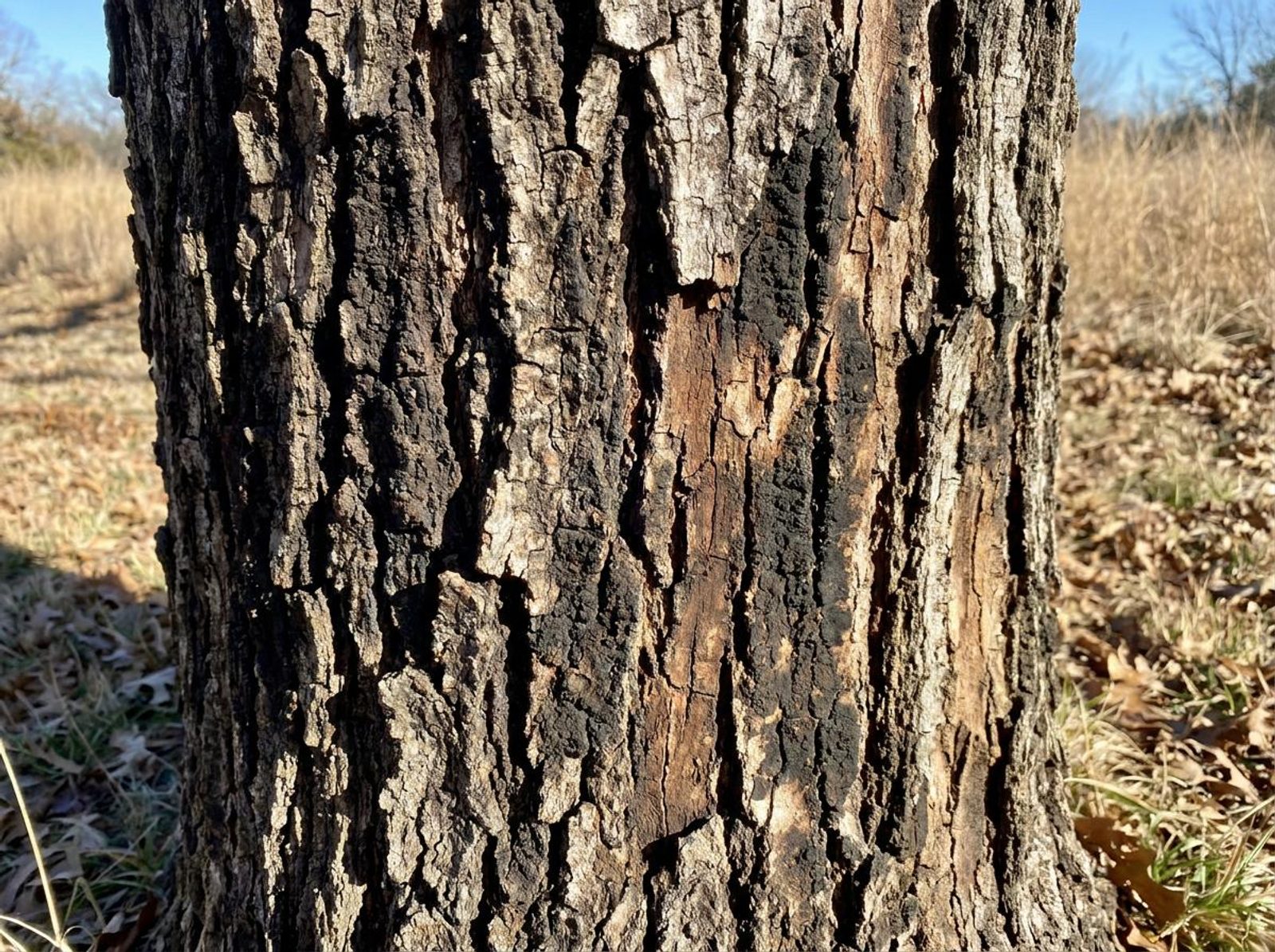
Biscogniauxia atropunctata (formerly Hypoxylon atropunctatum) is a fungus that colonizes oak trees already stressed by drought, root compaction, construction damage, or other diseases. It's everywhere in oak country — basically every mature oak carries the spores latent. The trees only develop visible canker when their natural defenses are down.
What it looks like:
- Patches of bark falling off in chunks, exposing the wood beneath
- The exposed wood develops a thin, dark, crusty layer (the fungal stroma) — often described as looking "sooty" or "burnt"
- Often starts on one side of the trunk or one major limb
- Progresses faster in dry years, slower in wet ones
What it doesn't look like: small isolated spots of darkening, normal corky outer bark, or moss/lichen growth (those are all cosmetic).
What to do: Once you can see Hypoxylon stroma on the trunk or a major limb, the tree's structural integrity is already compromised in that area. The fungus eats heartwood while leaving an outer shell intact, which makes affected trees deceptively dangerous — they look fine until they fail under wind load. Most affected oaks need to come down within 1-3 years.
A certified arborist can assess how much of the trunk is involved and whether the tree can be safely pruned (removing affected limbs) or needs complete removal. Don't trust an estimate from anyone who isn't certified — Hypoxylon assessment requires understanding the tree's structural mechanics.
2. Frost cracks and radial shake
Frost cracks happen when temperatures drop fast and the outer trunk contracts faster than the interior, splitting the bark vertically. You see them most often on the south or southwest side of trunks, on trees in open settings (lawns, pastures) without surrounding canopy protection.
What they look like:
- A single vertical split running 2-15 feet up the trunk
- Often on the sunny side (south/southwest)
- Edges may show callus formation — raised bark ridges where the tree is trying to close the wound
- Older cracks can have wide, healed-over scars
What to do: A shallow frost crack on an otherwise healthy tree usually heals over time. The tree forms a callus, the wound closes, and the tree lives a long life with a permanent structural weak spot.
A deep frost crack (more than 1-2 inches deep, several feet long) is more serious — and almost always becomes a vector for fungal infection. The exposed inner wood is a welcome mat for Hypoxylon and other decay fungi. The two problems compound: the crack lets in the fungus, the fungus prevents healing, the tree weakens, the crack widens.
If you see active staining or sooty fungal growth on the edges of a frost crack, get the tree evaluated. Removal may not be urgent, but it's coming.
3. Oak wilt
Oak wilt (Bretziella fagacearum) is the most aggressive oak disease in the U.S. It moves through a tree's vascular system, blocking water transport and killing the tree within months for red oaks, years for white oaks.
Oklahoma has documented oak wilt in several counties, including Tulsa County. It's less prevalent here than in central Texas (which is the U.S. oak wilt epicenter), but it's spreading.
What it looks like:
- Sudden wilting and browning of leaves, starting at the top of the tree and moving down
- Leaves often retain a green base while the tips and edges brown ("flag" symptom on the leaf)
- Defoliation in summer, when the tree should be in full leaf
- Death can come in weeks (red oak group) or years (white oak group, including post oak and bur oak)
How it spreads: Through root grafts between neighboring oaks, and through sap-feeding beetles that move from infected to healthy trees during the active spring period (roughly February through June in Oklahoma).
What to do: Don't prune oaks during the high-risk season (February-June). If you must prune, paint the cuts immediately with a sealant. If you suspect oak wilt, get a sample to OSU's Plant Disease and Insect Diagnostic Lab for confirmation. Once confirmed, options include trenching to sever root grafts, fungicide injection (effective on white oaks, less so on red oaks), and immediate removal of the infected tree to slow spread.
4. Bacterial wetwood / slime flux
Wetwood is a chronic bacterial infection inside the heartwood. It's rarely fatal but can stress the tree over time and is unsightly.
What it looks like:
- Wet, dark streaks running down the trunk from cracks or pruning wounds
- A sour, vinegar-like smell at the seepage point
- Foam or a slimy film at the source of the seep
What to do: Wetwood by itself usually doesn't require removal. Keep the tree healthy — proper watering, mulching, no soil compaction around the root zone — and the tree often lives with the infection for decades. If wetwood is combined with other issues (Hypoxylon, large cavities, structural lean), the cumulative risk goes up.
When to call
Call an arborist when you see any of:
- Bark falling off in chunks larger than your hand
- Black or sooty crust on exposed wood
- Vertical cracks deeper than your thumbnail can fit into
- Sudden mid-summer leaf loss on a section or whole tree
- Mushrooms or shelf fungi at the base or on the trunk
- Trees that look "thin" in the canopy compared to neighbors
An on-site evaluation typically takes 20-30 minutes. We don't charge for evaluation if removal or major pruning is the recommendation — it rolls into the work estimate.
Related
Worried about an oak on your property? Call (918) 359-5928 for a free evaluation.
Free tree health evaluation
Quick form — we'll text or call you within 1 hour.